


How Philanthropic Strategies May Enhance Your Legacy While Supporting Tax-Efficient Giving
A More Thoughtful Approach to Charitable Planning
Charitable giving begins as a series of annual decisions—supporting organizations that matter, responding to community needs, or contributing during year-end planning. Over time, however, those decisions may begin to intersect with broader financial considerations.
Appreciated assets may represent a meaningful portion of overall wealth. Liquidity events may introduce significant tax exposure. Estate plans may begin to reflect not only family priorities but also philanthropic intent. In these moments, charitable giving can evolve from a series of transactions into a more structured component of a comprehensive plan.
Two strategies that are often considered in this context are Donor-Advised Funds (DAFs) and Charitable Remainder Trusts (CRTs). While each operates differently, both may offer ways to integrate charitable goals with tax-aware planning, income considerations, and long-term legacy objectives.
Taking a closer look at how these strategies function—and where they may apply—can help bring greater clarity to decisions that might otherwise be made in isolation.
Donor-Advised Funds: Flexibility, Timing, and Control
A Donor-Advised Fund is, at its core, a charitable account established through a sponsoring organization. Once funded, the assets are irrevocably designated for charitable purposes, but the donor typically retains advisory privileges regarding how and when grants are distributed.
How the Strategy Typically Works
A contribution is made to the Donor-Advised Fund, often in the form of cash or appreciated securities. At the time of the contribution, the donor is eligible for a charitable income tax deduction, subject to the applicable limitations for the year of the gift.
Once inside the fund, the assets may be invested and grow tax-free. Over time, the donor can recommend grants to qualified charitable organizations, effectively separating the timing of the tax event from the timing of the charitable impact.
Where Donor-Advised Funds May Be Most Effective
One of the defining characteristics of a Donor-Advised Fund is flexibility. This can be particularly relevant in years where income is elevated, such as:
- A business sale or partial liquidity event
- A Roth conversion or other taxable strategy
- The exercise of stock options or receipt of deferred compensation
In these scenarios, contributing appreciated assets rather than cash may provide additional efficiency. By donating securities that have increased in value, the donor may avoid realizing capital gains while still receiving a deduction based on the fair market value of the asset.
Key Considerations
While the structure is relatively straightforward, several factors may influence how effective a Donor-Advised Fund can be within a broader plan:
- Contributions are irrevocable, meaning assets cannot be reclaimed once donated to the Donor-Advised Fund
- Charitable contribution deduction limits will apply depending on income and asset type (contributions in excess of the limitation may be carried forward for up to five years)
- The sponsoring organization retains ultimate control over grant approval
- Investment options are typically limited to those offered within the fund
Despite these considerations, Donor-Advised Funds are often viewed as a practical way to bring organization and intentionality to charitable giving, particularly when coordinated with broader tax planning strategies.
Sample Scenario (For Illustrative Purposes Only)
Donor-Advised Fund — Tax Planning and Flexibility
To illustrate how this strategy may be applied in practice, consider the following scenario:
Margaret, age 67, recently retired from a long career in corporate leadership. As part of her transition, she completed a partial Roth conversion and received a deferred compensation payout, resulting in a higher-than-usual income year.
Margaret has a long-standing commitment to several charitable organizations, including a regional healthcare foundation and a university scholarship program. Historically, she made annual cash gifts, but given the increased tax exposure from her recent income events, she began exploring whether a more structured approach to giving could align more effectively with her broader financial picture.
As part of ongoing discussions with her financial advisor, and within the context of her overall financial plan, Margaret evaluated whether establishing a Donor-Advised Fund could help address both her tax considerations and long-term charitable goals.
Rather than continuing to make annual cash contributions, she contributed a portfolio of appreciated securities that had been held for many years.
By doing so, Margaret is eligible for a charitable deduction based on the fair market value of the donated assets, subject to applicable limitations. At the same time, because the securities were contributed directly, she avoided realizing capital gains that might otherwise have been triggered through a sale.
Once inside the Donor-Advised Fund, the assets can be invested and may grow on a tax-free basis. Margaret now has the ability to make grants to her preferred charities over time, maintaining the same level of annual support while separating the timing of the tax benefit from the timing of the charitable distributions.
This approach allows her to address a higher-income year while continuing to support the organizations that are important to her—without needing to significantly alter her long-term giving intentions.
Charitable Remainder Trusts: Income and Long-Term Impact
While Donor-Advised Funds emphasize flexibility, Charitable Remainder Trusts introduce an additional dimension: income.
A Charitable Remainder Trust is an irrevocable trust that provides a stream of income to the donor or designated beneficiaries for a specified period, after which the remaining assets are distributed to one or more charitable organizations. A Charitable Remainder Annuity Trust (CRAT) distributes a fixed annuity amount each year, and additional contributions are not allowed. Charitable remainder unitrusts (CRUTs) distribute a fixed percentage based on the balance of the trust assets (revalued annually), and additional contributions can be made.
How the Strategy Typically Works
Assets—often ones that have appreciated significantly—are transferred into the trust. The charitable deduction is limited to the present value of the charitable organization’s remainder interest, subject to applicable limits. The trust may then sell the assets and reinvest the proceeds.
Like the Donor Advised Fund, because the trust itself is a charitable entity, the sale may occur without triggering immediate capital gains tax. Instead, the proceeds are used to generate income, which is distributed to the income beneficiary according to the structure of the trust. The income distributed to a non-charitable beneficiary will be taxable to the recipient based on the underlying income recognized by the trust.
At the end of the trust term—either after a set number of years or upon the death of the beneficiary—the remaining assets are directed to charity.
Where Charitable Remainder Trusts May Be Most Effective
Charitable Remainder Trusts are often considered in situations where there is a desire to:
- Convert a concentrated or illiquid position into a diversified portfolio
- Generate a predictable income stream
- Reduce the immediate tax impact of a large transaction
- Incorporate charitable giving into estate planning
For example, a business owner preparing for a sale may evaluate whether transferring a portion of ownership into a trust prior to the transaction could allow for a more tax-aware transition while still supporting long-term charitable goals.
Key Considerations
Charitable Remainder Trusts are more complex than Donor-Advised Funds and require careful structuring:
- The trust is irrevocable and must meet specific regulatory requirements
- Income distributions are subject to a defined payout structure
- The charitable remainder must meet minimum thresholds
- Administrative and legal costs may be higher
In addition, while the trust may eliminate immediate capital gains recognition, the income distributed over time will be subject to income tax depending on the character of the underlying earnings.
Sample Scenario (For Illustrative Purposes Only)
Charitable Remainder Trust — Income and Asset Transition
To illustrate how this strategy may be applied in practice, consider the following scenario:
David, age 54, is the founder and majority owner of a privately held manufacturing company. After decades of growth, he began considering a potential sale as part of his longer-term transition strategy.
A significant portion of David’s net worth is tied up in the business, with a relatively low cost basis. As a result, a full or partial sale could create substantial capital gains exposure in a single year. At the same time, David is beginning to think more intentionally about income planning, diversification, and the role of charitable giving in his overall financial plan.
In coordination with his financial advisor and broader planning team, David explored whether transferring a portion of his ownership interest into a Charitable Remainder Trust prior to a sale might be appropriate.
After working through the structure as part of his overall financial plan, he contributed a minority interest in the business to the trust and takes a charitable contribution deduction for the present value of the charitable remainder.
Following the contribution, the trust—rather than David personally—participates in the eventual sale of that portion of the business. Because the trust is a charitable entity, the sale may occur without triggering immediate capital gains tax at the time of the transaction.
The proceeds within the trust are then reinvested, and David receives an income stream based on the terms of the trust. This may provide a source of ongoing cash flow as he transitions away from the business, while also allowing for greater diversification of assets over time.
At the conclusion of the trust term, the remaining assets are directed to charitable organizations aligned with David’s interests, allowing him to incorporate a philanthropic component into the outcome of the business sale.
This structure introduces additional complexity and requires careful coordination, but in certain situations, it may provide a way to align liquidity, income planning, and charitable intent within a single framework.
Comparing the Two Approaches
While both strategies support charitable objectives, they serve different roles within a financial plan.
Side-by-Side Comparison
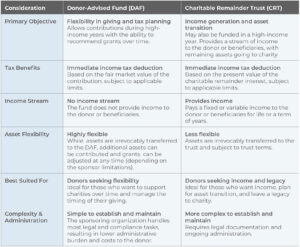
Used in Coordination
In some cases, the two strategies may be used in coordination—each addressing a different aspect of the overall plan.
A Coordinated Approach to Charitable Planning
Rather than viewing these strategies in isolation, it may be helpful to consider how they fit within a broader framework.
A Charitable Remainder Trust may address the need for income and tax-aware asset repositioning. A Donor-Advised Fund may provide flexibility in how charitable distributions are ultimately made.
When coordinated thoughtfully, these approaches may allow individuals to:
- Manage the timing of taxable events
- Create a structured income stream
- Support charitable organizations over time
- Align financial decisions with long-term legacy goals
Bringing It All Together
Charitable giving, when integrated into a broader financial plan, may offer more than immediate impact. It can become a tool for managing complexity—bringing together tax considerations, income needs, and philanthropic priorities in a more cohesive way.
Donor-Advised Funds and Charitable Remainder Trusts each provide a different lens through which to approach these decisions. Understanding how they function—and where they may fit—can help move charitable planning from a reactive exercise to a more intentional and strategic component of long-term planning.
If you would like more information about the terms and strategies discussed in this guide, or if you’re ready to explore how they apply to your specific situation, contact Waverly Advisors. With experience working with individuals, families, and executives managing significant wealth, we specialize in creating tailored strategies with the goal to help you grow, protect, and transfer your assets effectively.


