



“The big money is not in the buying and the selling, but in the waiting.” – Charlie Munger, Berkshire Hathaway
Markets hum along for months. Then the disruption arrives from nowhere — rising bond yields, a geopolitical flare-up, a downbeat earnings guidance that nobody saw coming. It doesn’t matter what triggers it.
What matters is who gets caught leaning offsides. Investors who spent the last year obsessing over performance suddenly find themselves staring at a portfolio value 20% lighter than it was a month ago.
They ask the inevitable question:
“What changes should we be making right now?”
It’s not the question that is troublesome. It’s the broken process and behavior that led to the question.
If you want to avoid this cycle of misery that could lead to an emotional portfolio decision, here is how you can do nothing, feel good about it, and carry on when the inevitable market disruption occurs.
Doing Nothing is a Decision
Doing nothing is arguably the most reliable form of investment returns. It’s also an art — not doing nothing out of neglect, but doing nothing on purpose, with conviction, while everyone around you is convinced something must be done.
Unfortunately, the entire financial complex wants you to act. Every economic report feels like it’s the most important ever. The quarterly earnings number for XYZ technology company is going to make or break the market.
It’s not an accident there aren’t any financial programs about doing nothing. Smart sounding guests talking about the trade they didn’t make, the earnings report they didn’t read, and the end of the world YouTube video ignored doesn’t exactly sell advertisements.
Doing nothing is the closest thing to a cheat code investing has, but cheat codes rarely make for a good story.
Business Insider published the famous study of the best performing accounts on Fidelity’s do-it-yourself platform were dead people or those that lost their passwords.
Wall Street Makes Money when you Panic
Nobody on Wall Street, financial media, or at a transaction-based shop gets paid when you sit still. The incentives around you are almost uniformly pointed toward activity — a trade, rotation, a “timely” idea or a new commission generating product. Doing nothing doesn’t generate a commission, a headline, or a hit of dopamine.
Action sells while doing nothing can come off as aloof and unsophisticated. Wall Street preys on this human quirk.
Build the Appropriate Portfolio Today
Doing nothing is easy when you’ve built a risk-aware, diversified portfolio before the correction hits. It’s nearly impossible when you’ve gotten over your skis’ reaching for return and see the losses piling up.
Retirees especially need to understand the game they’re playing: generate a reasonable return while managing risk, not maximize return while shunning risk management. The right portfolio isn’t the one that performs best when everything’s going up. It’s the one you can stick to when everything’s going down.
It’s easy to be an aggressive investor in a bull market — everyone’s a genius when stocks go up. The real test of a portfolio is how you behave when it’s down 40% and everyone around you is panicking. If your honest answer is “sell,” the portfolio was wrong before the correction. The correction just exposed it.
Performance With No Context for Risk
I’ve never seen so many retirees want to talk about performance, but have no clue how much risk they are taking.
Consider asking an investor which asset they would rather own…
Asset A – 20% annualized over the past 2.5 years
Asset B – 20% annualized over the past 2.5 years
One might conclude there’s no difference between Asset A & Asset B; until we uncover the journey…
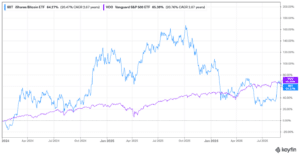
Source: Koyfin (9/1/2026)
In our previous example, Asset A is the S&P 500 (VOO) and Asset B is Bitcoin (IBIT). While each asset has virtually identical performance over 2.5 years, the journey is wildly different for Bitcoin. An investor that ignores an asset risk profile is setting themselves up for disappointment. In our opinion, an investor cannot talk about performance without talking about risk.
Effort Does Not Equal Success
In most aspects of life, effort and reward are linked.
Study harder, get better grades.
Hit the range more often, your handicap improves.
Put in more hours, get the promotion.
The market doesn’t run on that logic. You can be rewarded enormously for doing almost nothing, and punished severely for doing a lot.
That’s one of the most counterintuitive parts of investing: you’re not paid for effort; you’re paid for the quality of your decisions. The market doesn’t know if you watch CNBC every day. It doesn’t care if you spent a hundred hours on a research note or five minutes.
That mismatch creates a psychological problem. It’s uncomfortable to feel like you’re not doing anything, so investors manufacture activity to feel like they’re progressing — too many opinions, too much trading, constant tinkering.
They trade away the one thing that builds generational wealth: building a portfolio that reflects their investment personality and having enough self-awareness to get out of your own way.
Next time markets get difficult and the urge to do something shows up, remember: doing nothing is a decision too.
For more information on building a risk-aware asset allocation, shoot us a note at [email protected].


Waverly Quarterly Review & Market Outlook Q3 2026
In this video from Clay McDaniel, CFA®, Partner, Chief Investment Officer at Waverly Advisors, LLC, he discusses key takeaways from…