



“It’s not the Fed’s job to make investors happy. It’s the Fed’s job to keep the economy from overheating or freezing. Those are often different things.” – Anonymous
A new Fed chairman. Elevated valuations. Stubborn inflation. And a market that has been priced for perfection.
Historically, his combination has been a headwind for stock prices.
Coming into 2026, the consensus called for orderly rate cuts. The reality has been sticky inflation, economic resilience, and higher energy prices. Rate cut expectations flipped to rate hike expectations.
Throw in a new Fed voice that wants to make wholesale changes to how the central bank operates, and you have a potential disruption not many are talking about.
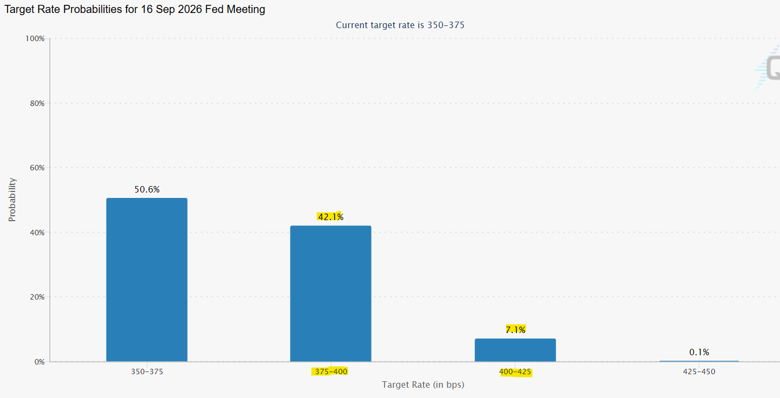
Source: CME Group Fed Futures (6/17/2026)
The above chart shows Fed Funds target rate probabilities for September 2026. The market is pricing in a 50% chance of higher interest rates by the end of summer.
Rate hikes are not inherently bad for stocks. The economy is usually growing when the Fed raises rates, which supports earnings. The problem isn’t the hike — it’s the setup when the hike arrives. Take 2021 as an example, everything from meme stocks to junk crypto currencies were trading at unreasonable levels. The Fed raised rates 11 times between March 2022 and July 2023. Growth and technology stocks, priced on cheap money assumptions, bore the brunt of it. The S&P 500 fell nearly 27% at its worst point, finishing 2022 down 18.1%.
The pattern is consistent. Rate hikes rarely cause the problem — they expose it. The damage is always worse when rates rise into an overvalued, crowded market.
Today, U.S. stocks are historically expensive by virtually every measure. The Buffett Indicator (total market cap to GDP) has never been higher. CAPE ratios above 35 have historically led to near-zero 10-year forward returns.
Even without actual rate hikes, Fed uncertainty has historically been enough to rattle markets.
When the path is unclear, markets don’t wait patiently, they can reprice aggressively (and often overreact).
Here’s what we are paying attention to during this unusual transition period for the Federal Reserve…
Rate Path Has Flipped
Sticky inflation, a resilient labor market, and rising energy costs have shifted the conversation from “how many cuts” to “could the next move be a hike.” As shown above, the CME FedWatch Tool now prices multiple hikes prior to year-end.
New Chair Who Wants to Rewrite the Playbook
Kevin Warsh was confirmed as the 17th Chair of the Federal Reserve on May 13, 2026. He isn’t just new to the chair — he’s promising wholesale changes to modernize the Fed.
Warsh has publicly signaled his intention to end the Fed’s practice of telegraphing rate decisions in advance, preferring less forward guidance and more policy flexibility. Following the Great Financial Crisis, Wall Street has gotten used to a Fed that over-communicates. Less Fed communication is probably a good thing in the long-run, but could cause some short-term noise in financial markets.

Source: Barclays, Bloomberg (6/17/2026)
The above graph shows the S&P 500’s drawdown three months after Fed Chair changes. The Fed would be in a difficult position without the change in leadership. The new Chair and his promise for reform & modernization add another wrinkle that investors might not like.
Washington Wants Rate Cuts
The administration has been vocal about its desire for lower rates to stimulate growth and ease the cost of servicing the national debt. That creates an uncomfortable dynamic: a new Fed chair with ties to the administration, an inflation picture that doesn’t support cuts, and a market trying to determine whether the Fed will follow the data or succumb to pressure from the White House.
The Inflation Picture Is Messy
Inflation is neither solved nor spiraling; it’s stuck. Core CPI remains above the Fed’s 2% target, energy costs have spiked due to geopolitical instability, and the labor market has softened without breaking. That combination gives the Fed no clean answer.
Cutting risks reigniting inflation. Hiking risks cracking a slowing economy. The result is a Fed sitting on its hands while the data sends mixed signals and a market that can’t price the path forward with any confidence.
Volatility Clusters Around Major Fed Pivots
When the Fed changes direction — from cutting to hiking or hiking to cutting — markets rarely take it in stride. The 2013 taper signal caused the tantrum. The 2022 pivot from near-zero rates to the fastest hiking cycle in four decades produced the worst year for a 60/40 portfolio in modern history.
The common thread isn’t the direction of the move — it’s the repricing of expectations that comes with it.
What This Means for Investors
The current setup stacks various Fed inflection points on top of each other — into a market that is already expensive, crowded, and concentrated in U.S. large-cap technology.
History has shown when these conditions converge, volatility tends to follow. And volatility, especially the sharp, unexpected kind, is most dangerous for investors who are extended and unprepared for it.
For retirees or near-retirees carrying concentrated equity exposure, this is the wrong time to be caught flat-footed.
For more information on how your portfolio could respond during a market correction, shoot us a note at [email protected].

