



Two people retire in the same year with a million dollars. They hold the same portfolio, withdraw the same amount, and earn the same average annual return over the next 25 years.
One of them runs out of money in year 17. The other still has assets at the end.
Nothing separates them except the order the returns arrived in. That’s sequence of returns risk, and we feel it’s the single most underappreciated threat to a retirement plan.
The Order of the Arithmetic
Let’s start with a fictional $1,000,000 portfolio. The retiree withdraws $50,000 in year one and increases the distribution by 3% annually. Assume a five-year return pattern that repeats: two down years and three up years, averaging 5% a year.
Marcus Webb gets the down years first. Ellen Reyes gets exactly the same returns, but in reverse order (good early, poor late).

Source: Claude (9/15/2026)
The table shows why the first few years matter once withdrawals begin. Marcus Webb takes the same $50,000 withdrawal just as the portfolio incurs two early losses, shrinking the base that remains invested for the later recovery. Ellen Reyes receives the same returns in reverse order, so the early gains build a larger cushion before the losses arrive. By year five, that timing difference creates a gap of about $145,000, even though both retirees started with the same balance, took the same withdrawals, and earned the same average return.
By the end of year five, the gap is about $145,000. That’s uncomfortable but survivable. The problem is what happens next, because the damage compounds.
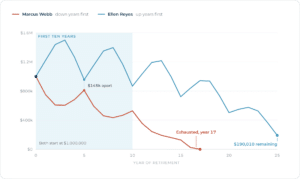
At year fifteen, Marcus is down to roughly $128,000 while Ellen holds about $722,000. Marcus’s portfolio is exhausted in year 17. Ellen finishes year 25 with roughly $190,000 still invested.
Source: Claude (9/15/2026)
The graphic shows how the same starting balance, withdrawals, and average returns can produce very different results depending on when good and bad years occur. Marcus runs out in year 17, while Ellen still has about $190,010 in year 25.
The part that makes it click
Run those same returns with no withdrawals at all, and both portfolios end at exactly the same number — about $2.27 million. Math doesn’t care about order. Add withdrawals and it’s a different story, because every dollar you take out during a downturn is a dollar that can never participate in the recovery.
Why This Doesn’t Matter While You’re Saving
During accumulation, a bad market early is arguably good news. You’re buying, and things are on sale. The dollar-cost-averaging math works in your favor, and you have decades for the recovery to arrive.
Retirement inverts every part of that. You’re selling instead of buying, so a decline forces you to liquidate more shares to fund the same lifestyle. Those shares are gone when the rebound comes. And your time horizon is shorter, so there’s less runway to recoup portfolio losses.
This is why the transition into retirement is the most fragile moment in a financial plan. The same market decline that would have been an opportunity at 45 could be a permanent impairment at 65.
The Danger Zone
Roughly the five years before retirement and the next few years after are when sequence risk does the most damage. Researchers sometimes call this the retirement red zone. Bill Bengen’s work makes the point plainly: the returns in the first five to ten years of retirement matter far more to the outcome than the returns in any later decade.
After this danger-zone window, one of two things usually happens: the portfolio grew early and built enough cushion to absorb later shocks, or it did not, and the plan needs to change. The window is when you still have options.
What Actually Reduces the Risk
You can’t control the order of returns. You can control how exposed you are to it.
- Know what you actually own. Diversification in your portfolio is low-hanging fruit for protection against a bad sequence. A portfolio concentrated in one sector, one stock, or one factor can fall further and take longer to recover than the broad market. Look through the holdings and understand your risk exposures — concentration in a former employer’s stock, overlapping funds that own the same names, or piling into AI/Technology stocks could impair the portfolio during a market sell-off.
- Hold a spending reserve. Having a cushion to cover one to three years of withdrawals in cash and short-term bonds means a bad year doesn’t force you to sell equities at a loss. This is the most direct defense available, and it’s mostly a structural decision rather than a market call.
- Build in spending flexibility. Dynamic spending strategies set boundaries around your withdrawal rate and can drastically improve your long-term plan. A retiree who can trim discretionary spending in a bad year is dramatically more resilient than one whose budget is entirely fixed.
- Consider a rising equity glide path. Reduce equity exposure heading into and through the early retirement years, then increase it later on. At some point in retirement, you may have more than enough to supplement your lifestyle. Your focus can shift toward investing for kids, grandkids, philanthropic goals, etc. The planning horizon may become longer again, which can support a more growth-oriented allocation.
- Keep Social Security as a flexible income lever. Delaying benefits can increase a guaranteed, inflation-adjusted income stream that the market can’t touch, but the claim date can also remain flexible. If early retirement markets are worse than expected, starting benefits sooner may reduce pressure on the portfolio when withdrawals are most damaging.That tradeoff is not automatic, and it depends on health, longevity, taxes, cash flow, and other household resources. The point is to preserve a choice. Holding the claiming decision open gives the plan another source of income that does not depend on what the market did last year.
- Separate essential from discretionary spending. Know which number you actually have to hit. Plans fail when everything is treated as fixed, and nothing can flex. Once the essential number is defined, you can see how much of it guaranteed income already covers — and how much is still riding on the portfolio in a down year.
The Practical Version
Sequence risk isn’t a reason to be afraid of retiring. It’s a reason to shift from a wealth building to a wealth preservation mindset. The skillset for building wealth and keeping wealth is completely different. Unfortunately, many retirees fail to turn off the “relentless pursuit of more” mindset.
That means knowing where the next few years of spending come from before you need it, having a plan for what you’d cut if markets fell off significantly, and understanding that the number you withdraw is a decision you’ll revisit frequently rather than a promise you made to yourself on day one.
Ready To Get Started?
We’ve made it simple to see your own numbers.
If you’d like guidance tailored to your own situation, reach out to us at [email protected].
This material is for educational and informational purposes only and should not be construed as tax, legal, or individualized investment advice. The illustration uses assumed returns and withdrawals selected to demonstrate a concept; it is not a forecast and does not reflect any actual investment. Withdrawal rate research cited includes William Bengen, A Richer Retirement (2025), and Morningstar’s State of Retirement Income research. Figures cited reflect information believed to be accurate as of publication and are subject to change. Illustrations are fictional and for illustrative purposes only, do not represent any actual client, and are not a projection of future results. Individual results will vary. Please consult a qualified tax, legal, or investment professional regarding your particular situation.

