


The standard career has been the same for decades. Work continuously, defer travel and fun projects, and eventually rest somewhere around 65. A growing number of professionals are rearranging that sequence, stepping away for a defined period mid-career and returning to work at a set date.
This pattern is called the “mini retirement,” and the question worth asking isn’t whether a break sounds appealing but whether a plan can realistically absorb one.
So, is this just a long vacation? Not quite. Three things set a mini retirement apart:
- It’s funded with intention and purpose
- It has a planned return to work
- It’s meant to happen more than once
In other words, it’s an intentional part of a career and financial plan that doesn’t move in a straight line.
Here’s the encouraging part: for most households we work with, a break like this is achievable. However, it isn’t free, and it isn’t something you want to improvise.
What the Data Shows
HSBC’s 2025 Quality of Life report, The Rise of Multi Retirements, surveyed affluent investors across twelve markets…
- Lower U.S. interest: 37% of U.S. investors plan a mini retirement, compared with 45% globally.
- Strong perceived benefit: 65% of U.S. respondents believe a break would improve quality of life, versus 74% worldwide.
- Higher savings hurdle: U.S. respondents estimate they need $1.57 million for a comfortable retirement, compared with the $1.05 million global average.
- Generational divide: Older respondents plan one late-career pause, while younger respondents envision multiple breaks that shape their careers.

Source: HSBC Quality of Life, The Rise of Multi Retirements, 2025 (7/29/2026)
The table shows the number, timing, and frequency of planned career breaks by generation. Baby Boomers most often expect one break, while most Gen Z and Millennial respondents expect two or three. Younger generations also plan to start earlier, and space breaks farther apart (figures are global).
Why Now?
A few things are pushing people in this direction:
- Shifting values: More people are measuring a good life in experiences and time, not just the numbers on their balance sheet.
- Anxiety about the future: Work is changing fast, and a plan that only pays off in thirty years feels like a massive bet.
- Shifting timelines: The traditional milestones like owning a house, having the “magic” retirement number, and getting to the finish line feel further out of reach, so waiting for them is less appealing.
- Health and family: Money can be earned later. Good health and young kids can’t.
- Flexibility is normal now: Remote work, contract roles, and sabbatical programs made stepping away and coming back a realistic move.

Source: Napkin AI (8/12/2026)
This graphic illustrates how systemic macroeconomic shifts have broken down the traditional work path, driving younger generations to adopt flexible careers and “mini retirements.” By highlighting an era of weakened employment contracts, AI-driven future uncertainty, and delayed financial rewards like affordable homeownership, it explains why workers are rejecting the uninterrupted 40-year grind. Instead of deferring recreation, young professionals are choosing intentional, periodic career breaks to combat burnout and reclaim their immediate freedom.
The linear career path isn’t disappearing, but these forces explain the appeal of integrating rest and the reinvention of working life.
What’s Realistic?
Financial constraints remain the biggest barrier.
The illustration below follows a hypothetical Oregon couple named Alex and Jordan. Both are 38 years old, with a combined income of $255,000, roughly $285,000 in invested assets, a home worth $545,000 against a $424,000 mortgage, and a 7-year-old child. They save consistently and plan to retire at 67.

Source: RightCapital (8/12/2026)
The graphic shows the median simulated value of the hypothetical couple’s invested assets, in today’s dollars, from age 38 through the end of the plan. Both work continuously to 67. The median portfolio value ends near $5.22 million.
Now assume each of them takes one year away from working full time.
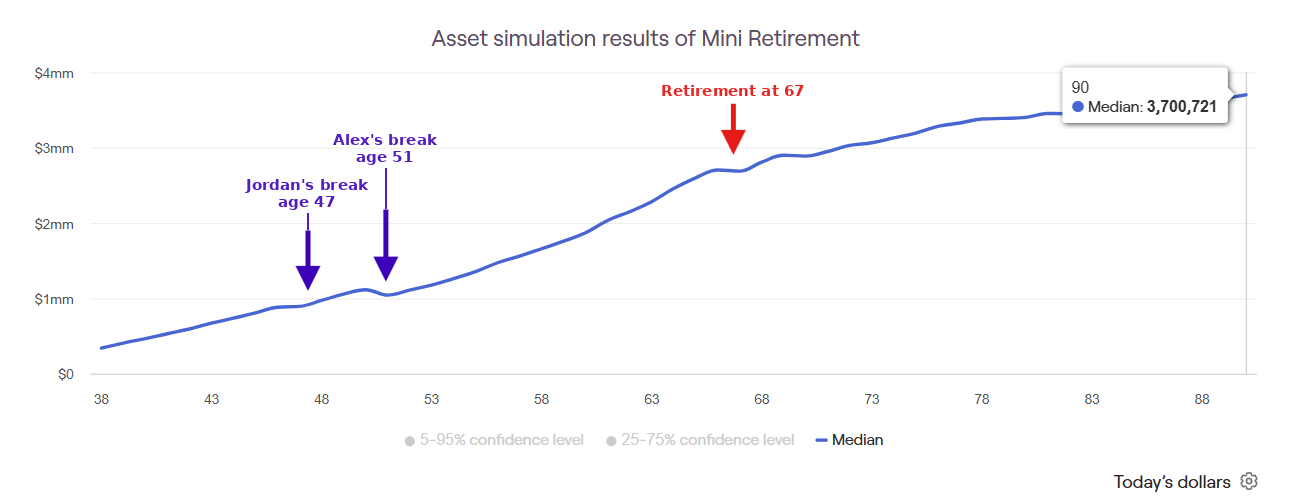
Jordan takes the first at 47, Alex the second at 51. Each includes a $20,000 allowance for travel and experiences on top of regular expenses. Additionally, retirement contributions pause each year, resume upon return, and each spouse returns to work earning 10% less than before.
Source: RightCapital (7/29/2026)
Adding one-year breaks at ages 47 and 51, plus a permanent 10% pay reduction after each return, creates the two dips shown above. During those years, contributions stop and the household draws from savings. The lifetime cost of these mini retirements is about $1.52 million compared with the continuous-work scenario, reducing the median ending value to approximately $3.7 million.
Health insurance is the cost most households underestimate here, but the illustration doesn’t include changes because the breaks are staggered. With one spouse working full-time during the other’s break, their family can move onto an employer plan, and the incremental cost would be the difference between individual and family coverage for a single year.
A household where both spouses step away at once would face a materially larger funding gap.
None of this argues against taking a break but hopefully puts things in perspective.
A successful break is funded, intentional, and supported by a financial plan.
- Runway. Save enough to cover the break and a delayed return.
- Long-term costs. Model lost contributions and compounding.
- Return. Plan for re-entry.
Lower-income years may also create tax-planning opportunities, such as completing Roth conversions at lower rates or reducing concentrated positions more tax-efficiently.
Planning for Time Well Spent
Mini retirement is a way to use planning more intentionally, making room for meaningful experiences today while protecting long-term financial security.
The goal isn’t simply to reach the finish line, but to build a plan that supports a life well lived along the way.
Get in Touch
Whether it’s savings, a Roth conversion, charitable giving, or simply a second set of eyes on the plan, we’re glad to help. Reach out to Team Lake Oswego at [email protected] to start a conversation, or your Advisor to schedule a review.
Interested in creating your own financial plan? Reach out to our team or click here to get started.


Waverly Quarterly Review & Market Outlook Q3 2026
In this video from Clay McDaniel, CFA®, Partner, Chief Investment Officer at Waverly Advisors, LLC, he discusses key takeaways from…