
Early Leaders are Seldom the Winners
“The biggest change in the world economy since the Industrial Revolution.” John Chambers, Cisco CEO, 1999
Sun Microsystems was the darling of the internet boom. The company provided servers that powered dot-com companies. Every company from Pets.com to TheGlobe.com needed Sun’s servers to power their websites.
During peak euphoria, Sun Microsystems had a market capitalization of ~$200 billion. It was one of the most valuable technology companies in the world.
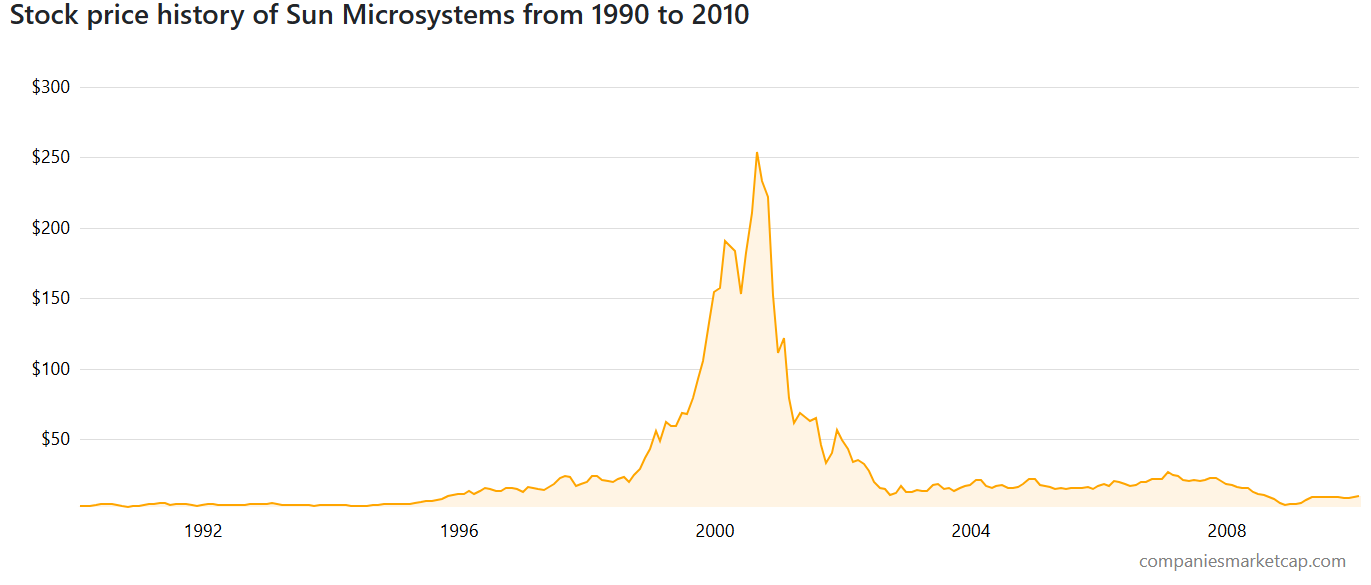
Source: Companiesmarketcap.com
The above chart shows the stock price of Sun Microsystems (1990-2010). Peak exuberance was reached in September 2001; Sun reached $257.25 per share. Investors were clamoring to own the stock at any price.
Sun Microsystems was the “pick and shovel” for the internet infrastructure buildout. During the massive capital expenditure cycle, dot-com companies; flush with venture capital cash, lined up to buy Sun’s servers. The servers equaled capacity, which would allow start-ups to large technology companies build their internet empires.
Unfortunately for Sun Microsystems, many of their customers had zero profits, no customers, and mounting debts. The attitude of “build it now and worry about profits later” proved disastrous. Server demand collapsed as many of Sun’s customers went bankrupt.
Sun Microsystems never fully recovered. The company was purchased by Oracle in 2010 for $7.4 billion; this was a fraction of the peak valuation of $200+ billion.
After the technology bubble burst, Sun Microsystems CEO Scott McNealy offered a quote that captures the essence of the irrational speculation surrounding his company…
“At 10 times revenues, to give you a 10-year payback, I have to pay you 100% of revenues for 10 straight years in dividends. That assumes zero cost of goods sold… That assumes no expenses… That assumes I can maintain current revenue for 10 straight years. Now, having done that, would any of you like to buy my stock at $64?”
In hindsight, the mass hysteria surrounding Sun’s stock price didn’t pass basic arithmetic.
Sun was hardly alone; many early leaders of the internet boom fell by the wayside…
Nortel Networks – Borrowed heavily to build internet infrastructure. Massively overbuilt capacity. Eventually went bankrupt in 2009 wiping out equity investors.
Netscape – the first internet browser that built a dominant position as the original gateway to the web. Microsoft responded by launching Internet Explorer and bundling it within Windows. Netscape’s browser share cratered and the company was eventually acquired by AOL (another early leader casualty).
It would seem the early leaders of the internet boom were not the end game winners.
While the internet boom and the current AI cycle are not the same, there are parallels.
- Massive Capital Expenditures
- Investor Euphoria
- Potentially transformative technology
- Productivity gains could structurally raise growth
- Investment, speed, and capacity are a priority over profits
Even the Nasdaq’s journey after Netscape and ChatGPT were released are eerily similar…

Source: Bespoke Investment Group
The above chart shows the Nasdaq’s percentage change from Netscape’s release in 1994 vs. Chat GPT’s release in 2022. It’s scary how similar the Nasdaq’s journey is between the two technological breakthroughs. The chart doesn’t show the bust that followed in the spring of 2000.
What must go right for the massive capital expenditures in AI to pay off?
- Productivity gains or increased output per worker
- Corporations must fully deploy AI across their enterprises
- AI usage must increase
- Power and energy infrastructure must keep pace
- The ability and willingness to fund massive capital expenditure requirements
- Regulatory framework is clear, fair, and unburdensome to innovation while protecting consumer data (that’s big ask).
We don’t pretend to know how the AI story ends, but it would seem much has to go right to support the current level of capital expenditures. If we learned anything from the internet boom & bust, there will be winners and losers (known as creative destruction).
During the dot-com bust, the winners were second wave companies that built upon the infrastructure created during the bubble phase.
These second wave companies have more fiscally disciplined, focusing more on profitability than investment.
- Google (founded 1998, IPO 2004)
- Facebook (founded 2004)
- Netflix (streaming pivot 2007)
- Apple (iPhone 2007)
- Cloud-native companies (Salesforce, Amazon Web Services)
We are not saying the AI cycle will mirror the internet boom & bust cycle. However, we can learn from history to make better investment decisions.
Early leaders do not necessarily mean long-term winners. There will likely be a period of creative destruction where investment darlings become ugly ducklings.
Be mindful of the concentration risk of popular market cap weighted funds & ETFs (S&P 500) or over-allocation to a single theme or company.
If you own the S&P 500, Nasdaq, and individual technology stocks, you are making the same bet under the guise of diversification.
Many investors shovel money into the best performing themes of the day; thinking current conditions will continue uninterrupted. The only certainty in investing is change.
If you need help understanding what you own or how to tighten up risk, shoot us a note at [email protected].

Written by Nik Schuurmans, CFA®
Nik Schuurmans joined Waverly Advisors in January 2026 after Pure Portfolios was acquired by Waverly Advisors, LLC. As Partner and Wealth Advisor, Nik operates using a transparent and pioneering fee structure, to provide a modern wealth management experience for every client. Nik believes access to professional advice should not come with exorbitant fees, misaligned incentives, and conflicts of interest. Learn More About Nik…
Important Disclosure Information – Waverly Advisors (waverly-advisors.com)
Disclosure: Waverly Advisors, LLC (“Waverly”) is an SEC-registered investment adviser. A copy of Waverly’s current written disclosure Brochure and Form CRS (Customer Relationship Summary) discussing our advisory services and fees remains available at https://waverly-advisors.com/.Past performance may not be indicative of future results. Different types of investments involve varying degrees of risk. Therefore, it should not be assumed that future performance of any specific investment or investment strategy (including the investments and/or investment strategies recommended and/or undertaken by Waverly Advisors, LLC, or any non-investment related services, will be profitable, equal any historical performance level(s), be suitable for your portfolio or individual situation, or prove successful. Forward-looking statements cannot be guaranteed. Due to various factors, including changing market conditions and/or applicable laws, the content may no longer be reflective of current opinions or positions. Moreover, you should not assume that any information provided serves as the receipt of, or as a substitute for, personalized investment advice from Waverly Advisors.”
Back to Resources