
Markets After Major Geopolitical Events
Originally Published: June 20, 2025
“The world changes. This is the biggest problem in markets.” – Bill Miller, former chairmen of Legg Mason Capital Management
T. Rowe Price, founder of the Baltimore-based investment firm that bears his name, wrote an essay in 1937 titled, “Change – the Investor’s Only Certainty.”
The world was on the doorstep of WWII. Many investors were attempting to assess Adolf Hitler’s intentions.
Price wrote, “Germany will acquire territory, preferably through peaceful means.”
Two years later, Hitler invaded Poland, plunging the world into six years of war. Everything changed, but not in ways that Price or anyone else could predict. (source: “Richer, Wiser, Happier” by William Green).
On Friday, April 12th, 2024, global financial markets were anticipating an Iranian strike on Israel.
Major U.S. indices retreated ~1.5%.
Over the weekend that followed, Iran launched an attack on Israel.
As of this writing, markets are skittish on a potential Israeli response.
A bit more than a year later, the Israel – Iran conflict has flared up again.
On 6/13/25, Israel launched Operation “Rising Lion” conducting airstrikes on ~100 Iranian military/nuclear targets.
In the following days, Iranian missile barrages hit Israeli cities casualties and damage.
Israel strikes Iran’s missile infrastructure near Tehran; Iran’s Supreme Leader Khamenei vows “the battle begins.”
We don’t pretend to know how the conflict plays out. We can provide historical context with previous geopolitical events, which asset classes investors flock to, and how an investor can frame the range of potential outcomes.
How do markets react to unpredictable and random geopolitical events?
It’s complicated.
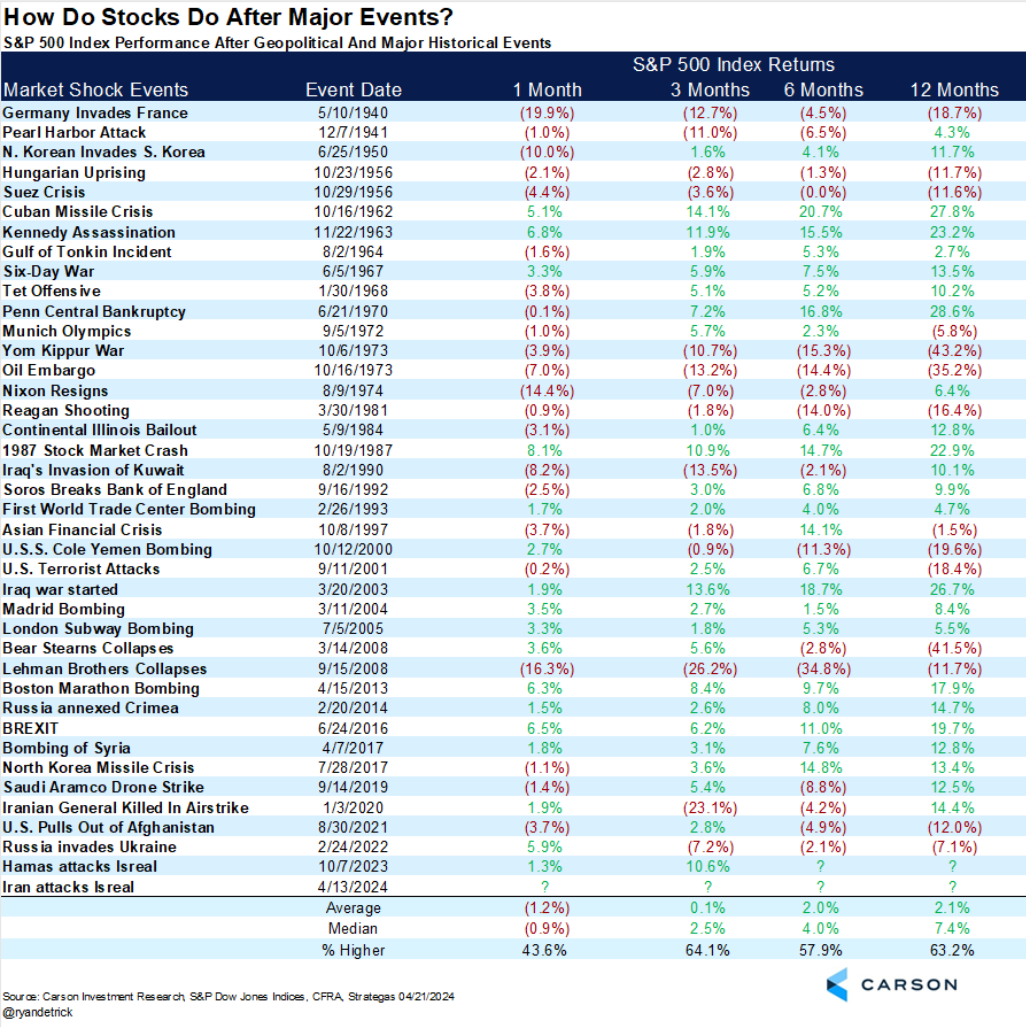
Ryan Detrick, Chief Market Strategist at Carson Group, shared historical stock returns after major geopolitical events…
Source: Ryan Detrick, Carson Group
The above chart shows S&P 500 returns for one, three, six, and 12 months following major geopolitical events. The bottom of the chart compares average, median, and percentage of the time higher vs. all years (1950 – 2023). Across average & median returns, there is evidence to suggest geopolitical events are followed by lower S&P 500 returns.
It seems average returns are lower following major geopolitical events; however, the market returns for individual events are all over the place.
On 2/24/22 Russia invaded Ukraine. The S&P 500 was ~6% higher one month later.
On 8/2/1990, Iraq invaded Kuwait. The S&P 500 was ~8% lower one month later.
Confoundingly, the Israeli ETF (EIS) hit an all-time high on Monday, June 16th…

Source: Bespoke Investment Group
This chart is shown for illustrative purposes only and does not represent actual client holdings. The securities identified are not recommendations to buy or sell and are not indicative of any client account. Past performance is not indicative of future results.
The above graph shows the Israel ETF (ticker EIS) since inception through 6/16/2025. Despite being mired in conflict since late 2023, the Israeli stock market has been on quite the run higher.
How can investors try to protect their portfolio against random geopolitical events?
Historically, gold, U.S. Treasuries, and the U.S. Dollar have been safe havens…

Source: Koyfin
This chart is shown for illustrative purposes only and does not represent actual client holdings. The securities identified are not recommendations to buy or sell and are not indicative of any client account. Past performance is not indicative of future results.
The above chart shows the year-to-date percentage change in Gold (SGOL, blue), U.S. Dollar (UUP, purple), short-term U.S. Treasuries (SCHO, orange), and intermediate U.S. Treasuries (SCHR, yellow). Since June 2nd, all four asset classes are positive. It would seem investors still seek refuge in the U.S. Dollar, Treasuries, and Gold during geopolitical flare-ups.
We should note safe-haven assets often move higher before an event happens. This might run counter to how most investors think, i.e. a geopolitical event happens and then we should seek safe-haven assets. Unfortunately, in most cases it’s too late. The umbrella is needed before it starts raining.
What can we learn from market returns and previous geopolitical events?
- Geopolitical events often come out of the blue. This is consistent with our belief that what derails markets is seldom what people are talking about.
- While average returns are lower following major geopolitical events, the market returns for individual events are all over the place.
- Trying to predict how markets react to geopolitical events is darn near impossible.
- Events that impact supply chains, transportation, oil/energy prices, food supply, and the global financial system seem to have the most impact on market returns.
- Gold, U.S. Treasuries, and the U.S, Dollar have typically held up well during geopolitical conflicts.
In my opinion, most geopolitical events aren’t tradable. If you’re freaking out about what could happen to your portfolio, it’s a strong sign you’re taking too much risk.
*The original version of this blog was penned on 4/18/24. We have refreshed the data to reflect the latest Israel/Iran conflict*
Your Wall Street advisor works for a bank. We work for you. Find out why clients of traditional 1% advisors are switching to Waverly Advisors.
Have a question or comment? Shoot us a note at [email protected].

Written by Nik Schuurmans, CFA®
Nik Schuurmans joined Waverly Advisors in January 2026 after Pure Portfolios was acquired by Waverly Advisors, LLC. As Partner and Wealth Advisor, Nik operates using a transparent and pioneering fee structure, to provide a modern wealth management experience for every client. Nik believes access to professional advice should not come with exorbitant fees, misaligned incentives, and conflicts of interest. Learn More About Nik…
Important Disclosure Information – Waverly Advisors (waverly-advisors.com)
Disclosure: Past performance may not be indicative of future results. The opinions expressed in this commentary reflect information available at the time it was written and should be used as a reference only. Due to various factors, including changing market conditions, economic conditions, and/or applicable laws, the content may no longer be reflective of current opinions or positions. Moreover, you should not assume that any discussion or information contained in this commentary serves as the receipt of, or as a substitute for, personalized investment advice from Waverly. If you have any questions regarding the applicability of any specific issue discussed above to your individual situation, you are encouraged to consult with your Waverly adviser or the professional advisor of your choosing. A copy of Waverly’s current written disclosure Brochure discussing our advisory services and fees is available for review upon request or by visiting https://waverly-advisors.com/ADV-Part-2A-Brochure. Please see additional important disclosures on the last page of this report.
Back to Resources