
The Three Headed Monster
“Everything feels unprecedented when you haven’t engaged with history.” – Morgan Housel, author of Same as Ever
What does the 10-year U.S. Treasury yield, crude oil, and the U.S. Dollar index have in common?
Large movements in the trio have historically been a precursor for equity volatility.
Our long-time research partner Bespoke Investment Group has dubbed bond yields, crude oil, and the U.S. Dollar the Three Headed Monster.
For good reason, changes in bond yields, crude oil prices, and swings in the U.S. dollar can have an outsized impact on global equity markets.
When all three rise together, it usually means inflation pressure, restrictive monetary policy (higher interest rates), and a flight to safety. Historically, that combination has been a headwind for stock prices.
The opposite is also true; lower borrowing costs, lower consumer prices, and weaker U.S. dollar can be a tailwind to stock prices.
U.S. 10-Year Yield

Source: Bespoke Investment Group
The above graph shows the U.S. 10-Year Treasury yield over the past 12 months. After the U.S. – Iran conflict broke out, the 10-Year yield spiked pricing in higher inflation due to oil supply chain disruptions.
Crude Oil

Source: Bespoke Investment Group
The above graph shows the price per barrel of WTI Crude Oil over the past 12 months. The Strait of Hormuz sees 20% of the world’s oil pass through each year. A prolonged closure would likely mean a dramatic spike in oil prices, which could mean higher prices for consumers.
U.S. Dollar

Source: Bespoke Investment Group
The above chart shows the U.S. Dollar Index vs. a basket of global currencies. When the line is going up, the Dollar is getting stronger. Large upward movements in the Dollar during a geopolitical event usually signal a flight to safety. Despite the “sell America” narrative, global investors still want to hold U.S. assets during times of market stress.
When we combine the 10-year yield, crude oil, and U.S. Dollar’s average level relative to the past year, current levels are hovering near the top of the 52-week range…

Source: Bespoke Investment Group
The above graph shows the Three Headed Monster over the past year. The current reading (as of 3/6/26), is the highest since 2/25/25.
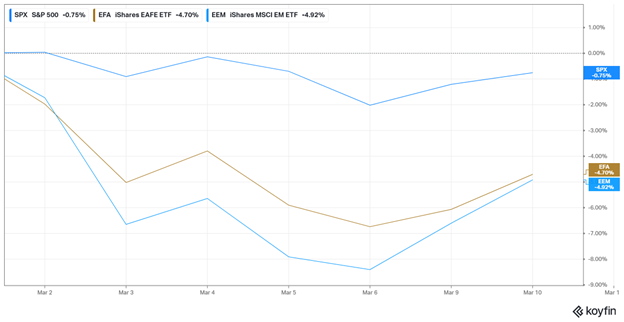
Not surprisingly, global markets felt some downward pressure…
Source: Koyfin
The above graph shows the performance month-to-date (as of 3/10/26) for the S&P 500 (blue), international developed stocks (brown), and emerging markets (EEM, light blue). Thusfar, the global market sell-off has been muted relative to history, but that could change the longer the conflict goes on (see “Geopolitical Events & Future Returns”).
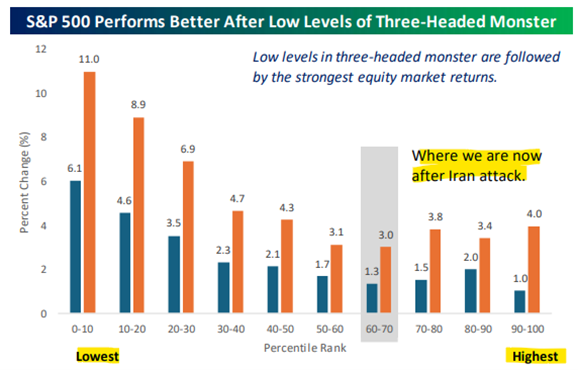
How does the S&P 500 perform at various levels of the Three Headed Monster?
History would suggest it’s much better for stocks when yields, oil, and the U.S. Dollar are at low levels.
Source: Bespoke Investment Group
The above graph shows future 3-month (blue) & 6-month (orange) returns for the S&P 500 for various levels of the Three Headed Monster. The lowest readings (left side) show the highest future returns, while the highest levels show challenged returns. As of 3/6/26, the Three Headed Monster is in the 60-70th percentile of historical readings, which means if current levels hold, future returns could be muted.
Here’s another look at future S&P 500 performance given various levels of the Three Headed Monster (this chart looks ahead one year). Again, we see the highest S&P 500 returns originated from lower bond yields, lower oil prices, and a weak U.S. Dollar.

Source: Bespoke Investment Group
The above graph shows elevated bond yields, oil prices, and a stronger U.S. dollar (red) historically have led to lower future returns across multiple time horizons.
It would seem the Three Headed Monster of bond yields, oil prices, and the U.S. Dollar have a sizable impact on volatility and global asset prices. The evidence-based investor can better understand what’s happening by leaning into history and taking cues from the market versus playing the prediction oracle.
Unfortunately, many advisors and do-it-yourself investors rely on short-term headlines and emotion to make investment decisions.
William Green, author of “Richer, Wiser, Happier,”…
“Most people make their investment decisions on the basis of an unreliable hodgepodge of half-baked logic, biases, hunches, emotion, and vague fantasies or fears about the future.”
We prefer empirical data, evidence, and the relentless pursuit of what works.
If you need help stripping emotion out of the investment process, shoot us a note at [email protected].

Written by Nik Schuurmans, CFA®
Nik Schuurmans joined Waverly Advisors in January 2026 after Pure Portfolios was acquired by Waverly Advisors, LLC. As Partner and Wealth Advisor, Nik operates using a transparent and pioneering fee structure, to provide a modern wealth management experience for every client. Nik believes access to professional advice should not come with exorbitant fees, misaligned incentives, and conflicts of interest. Learn More About Nik…
Important Disclosure Information – Waverly Advisors (waverly-advisors.com)
Disclosure: Waverly Advisors, LLC (“Waverly”) is an SEC-registered investment adviser. A copy of Waverly’s current written disclosure Brochure and Form CRS (Customer Relationship Summary) discussing our advisory services and fees remains available at https://waverly-advisors.com/.Past performance may not be indicative of future results. Different types of investments involve varying degrees of risk. Therefore, it should not be assumed that future performance of any specific investment or investment strategy (including the investments and/or investment strategies recommended and/or undertaken by Waverly Advisors, LLC, or any non-investment related services, will be profitable, equal any historical performance level(s), be suitable for your portfolio or individual situation, or prove successful. Forward-looking statements cannot be guaranteed. Due to various factors, including changing market conditions and/or applicable laws, the content may no longer be reflective of current opinions or positions. Moreover, you should not assume that any information provided serves as the receipt of, or as a substitute for, personalized investment advice from Waverly Advisors.”
Back to Resources