
We Asked AI to Build an Investment Portfolio

“What the human being is best at doing is interpreting all new information so that their prior conclusions remain intact.” – Warren Buffett
We have been early adopters of AI. It’s great at parsing information quickly, summarizing earnings reports, editing content, etc.
We’ve heard from several prospective clients that they were using AI to build an investment portfolio.
“I’ll just ask Chat GPT.”
We were curious and decided to give it a try.
Here’s the profile we gave Claude…
“I’m married. Age 65. Live in Oregon. $90,000 in combined income from social security and pension. $2,000,000 in joint taxable brokerage account, $1,000,000 traditional IRA, $250,000 Roth IRA.”
Source: Claude (6/22/2026)
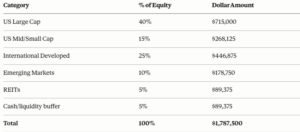
The above graph shows Claude’s initial equity asset allocation. This was a little confusing as it only showed the equity portion of the portfolio. We had to ask it to include the fixed income (bond) portfolio as well.
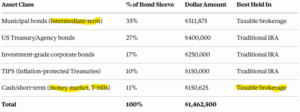
After asking to see the bond portfolio, Claude came back with this…
Source: Claude (6/22/2026)
The above chart shows the bond portfolio for our retiree example. We like that it shows which account to own each type of bond. This is often overlooked by advisors, which results in unnecessary taxable income. We would push back on taxable money market and T-bills in the taxable account (bottom) and the bulk of the municipal bond portfolio in 7-10 year, intermediate bonds. However, all in all, not too bad.
Most prospective clients we speak to are making a massive bet on tech/AI stocks or want to own more; we added a few additional details…
“I really like technology investments and think the AI trend is only getting started. I don’t want to miss out on potential gains. I prefer to own more AI and S&P 500, that’s been the best performing area.”
After some light push back, Claude obliged…
Source: Claude (6/22/2026)
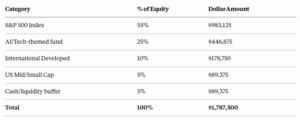
The above chart shows Claude’s updated tech/AI allocation. In fairness, Claude did warn us that this was a “concentrated growth allocation.” However, AI was more than happy to comply with our request for more of what’s been working.
It would seem any human bias can easily show up in Claude’s recommendations. If we want more performance, the model complies. If we are skittish, the model complies.
Here are some other factors to consider when using AI for investment guidance and portfolio construction…
Training data skews recent. The last decade of market data is dominated by a historic U.S. large-cap and technology run. Most AI models express a large “home-bias”, which means over-allocating to U.S. large cap. Our original allocation had ~40% in U.S. large cap stocks.
Stale Data. I’ve seen folks online post about using AI for short-term trading ideas. The output is only as good as the data AI trains on. Most AI models are using “stale” or market data that is several days old. This can result in false & misleading signals. There are programs to feed live market data into AI, but it can be costly.
Overconfidence Bias. It’s easy to be an investor in a market where everything goes up. A bull market hides a ton of misallocation mistakes. It is almost impossible to recreate the fear, panic, and emotion that comes with a sharp market sell-off.
The Model has No Fiduciary Duty. AI isn’t required to ask whether a 60% tech concentration is appropriate for someone three years from retirement. It answers the question asked, not the question that should be asked.
AI is Agreeable. AI wants to please. It’s not in business to make the user feel worse about themselves. If you’re a wildly optimistic investor, the model with cheer you on and confirm your bullish thesis. If you’re a pessimistic investor, AI will highlight all the things that could derail the market. You want an mechanism to challenge biases and blind spots, not confirm them.
No Accountability. A human advisor lives with the consequences of poor allocation decisions. The model moves on to the next chat.
No objective filter between you and the money. When there’s no objective filter between the investor and the money, the higher likelihood of making a misallocation mistake. We’ve seen folks refuse to pay an advisor $10,000 per year, only to make $100,000 mistakes due to behavioral or allocation leaks.
It turns out AI might agree with the above, Claude has the following disclaimer…
This document is an educational framework, not individualized investment, tax, or legal advice. It does not account for the couple’s full financial picture, health status, spending needs, or legacy goals. Please review with a fee-only CFP®, CFA, or CPA before implementing.
AI’s great for many things in the investment process; parsing earnings reports, simplifying data, summarizing CEO/CFO comments, organizing information, etc. However, solving for human emotion, panic, and greed is not a math equation.
When I asked a friend that works in AI about potential job displacement, he asked the following question…
Do you want a novice using AI to fix your plumbing or a plumber with 30 years’ experience using AI to fix your plumbing?
In our opinion, the future of investment management is experienced, credentialed advisors powered by AI.
If you have questions on portfolio construction, risk management, or tax-efficient investing, shoot us a note at [email protected].
 Written by Nik Schuurmans, CFA®
Nik Schuurmans joined Waverly Advisors in January 2026 after Pure Portfolios was acquired by Waverly Advisors, LLC. As Partner and Wealth Advisor, Nik operates using a transparent and pioneering fee structure, to provide a modern wealth management experience for every client. Nik believes access to professional advice should not come with exorbitant fees, misaligned incentives, and conflicts of interest. Learn more about Nik…
Important Disclosure Information – Waverly Advisors (waverly-advisors.com)
Disclosure: Past performance may not be indicative of future results. The opinions expressed in this commentary reflect information available at the time it was written and should be used as a reference only. Due to various factors, including changing market conditions, economic conditions, and/or applicable laws, the content may no longer be reflective of current opinions or positions. Moreover, you should not assume that any discussion or information contained in this commentary serves as the receipt of, or as a substitute for, personalized investment advice from Waverly. If you have any questions regarding the applicability of any specific issue discussed above to your individual situation, you are encouraged to consult with your Waverly adviser or the professional advisor of your choosing. A copy of Waverly’s current written disclosure Brochure discussing our advisory services and fees is available for review upon request or by visiting https://waverly-advisors.com/ADV-Part-2A-Brochure. Please see additional important disclosures on the last page of this report.